

[Latest] Global Microbial Biostimulants Market Size/Share Worth USD 13.88 Billion by 2034 at a 10.5% CAGR: Custom Market Insights (Analysis, Outlook, Leaders, Report, Trends, Forecast, Segmentation, Growth, Growth Rate, Value)
[220+ Pages Latest Report] According to a market research study published by Custom Market Insights, the demand analysis of Global Microbial Biostimulants Market size & share revenue was valued at approximately USD 5.10 Billion in 2024 and is expected to reach USD 5.64 Billion in 2025 and is expected to reach around USD 13.88 Billion by 2034, at a CAGR of 10.5% between 2025 and 2034. The key market players listed in the report with their sales, revenues and strategies are BASF SE, Syngenta AG, Bayer AG, UPL Limited, Valagro S.p.A. (Syngenta Group), Isagro S.p.A. (Gowan Group), Italpollina S.p.A., Biolchim S.p.A., Koppert Biological Systems, Novozymes A/S (Novonesis Group), Lallemand Plant Care, BioWorks Inc., Andermatt Biocontrol AG, Agrinos AS, Atlantica Agricola, Symborg S.L. (Corteva Agriscience), Plant Response Biotech Inc. (Marrone Bio + Bioceres Crop Solutions), Acadian Plant Healt
Austin, TX, USA, Aug. 12, 2026 (GLOBE NEWSWIRE) -- Custom Market Insights has published a new research report titled “Microbial Biostimulants Market Size, Trends and Insights By Microbial Source (Bacteria, Fungi, Algae & Cyanobacteria, Actinomycetes & Others), By Formulation (Liquid, Granular, Powder), By Application (Crop Production, Soil Health Improvement, Plant Stress Management, Seed Treatment), and By Region - Global Industry Overview, Statistical Data, Competitive Analysis, Share, Outlook, and Forecast 2025 – 2034” in its research database.
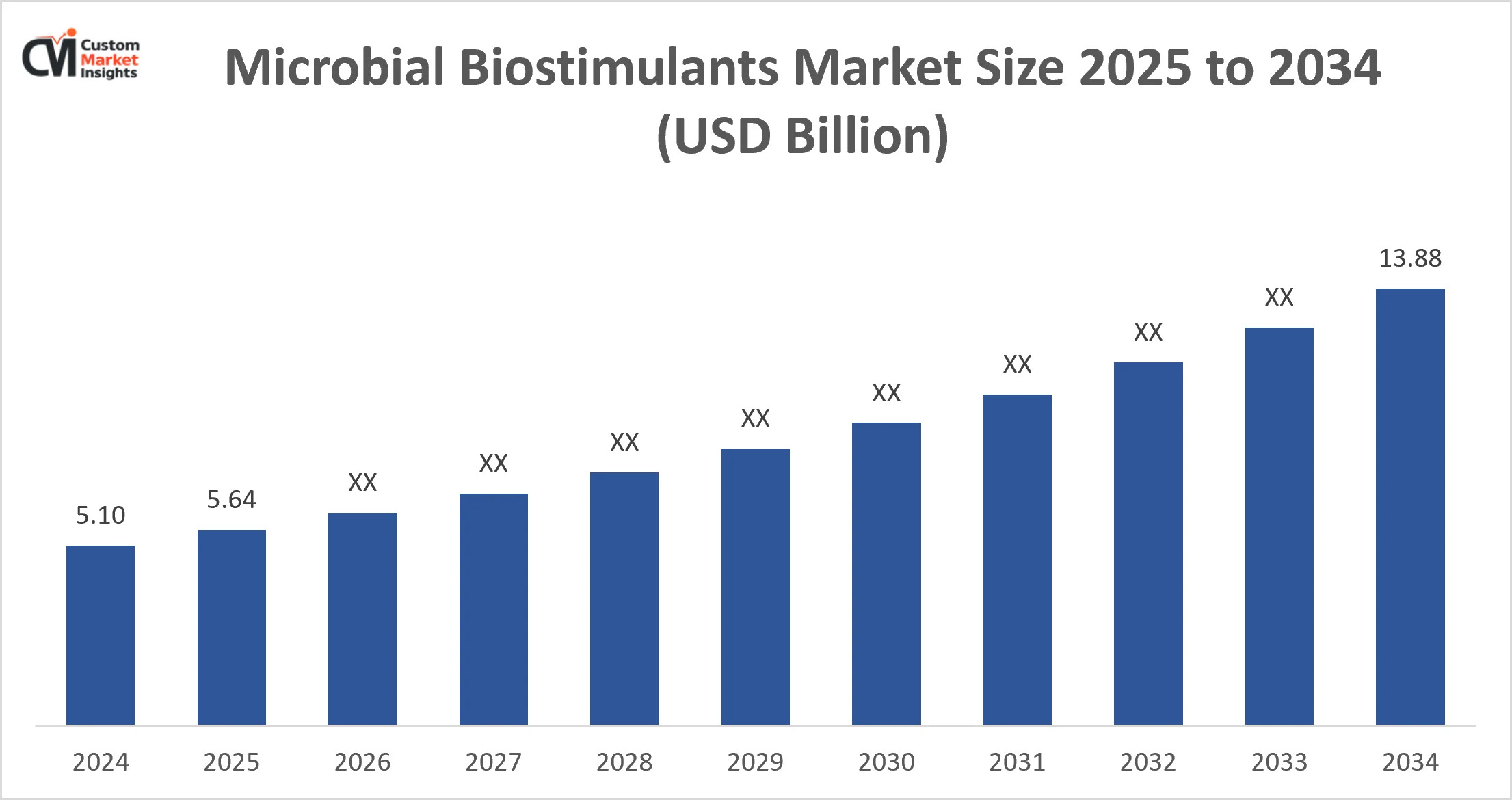
“According to the latest research study, the demand of the global Microbial Biostimulants Market size & share was valued at approximately USD 5.10 billion in 2024 and is expected to reach USD 5.64 billion in 2025 and is expected to reach a value of around USD 13.88 billion by 2034, at a compound annual growth rate (CAGR) of about 10.5% during the forecast period 2025 to 2034.”
Click Here to Access a Free Sample Report of the Global Microbial Biostimulants Market @ https://www.custommarketinsights.com/request-for-free-sample/?reportid=73702
Overview
According to industry analysts at CMI, the global trend for sustainable and eco-friendly agriculture is a primary driver for microbial biostimulants. The farmers and policymakers are giving more emphasis to soil and its health, along with productivity, and less to chemical fertilizers. Microbial biostimulants actually induce stresses for the plants, such as drought, salinity, and temperature, to increase nutrient and root uptake, which is one of the biggest challenges under climate-change pressure.
The consumer inclination being increasingly in favor of organic and residue-free produce is enhancing adoption in large parts of Europe and North America. Across Asia-Pacific and Latin America, small-scale farmers have been utilizing several types of microbial inputs in order to improve yield as well as soil fertility. Evolution in microorganism strain development, favoring government policies, and integration into precision agriculture become instrumental factors propelling the market growth in various fields of crop cultivation.
Request a Customized Copy of the Microbial Biostimulants Market Report @ https://www.custommarketinsights.com/request-for-customization/?reportid=73702
Key Trends & Drivers
- Organic and Sustainable Farming in the Rise: The rising demand for organic and residue-free crops has been pushing farmers toward eco-friendly production inputs. Microbial biostimulants enter organic certification schemes and enhance the quality of crops while lowering synthetic fertilizer use. This trend is most vigorous in Europe and North America, where their regulatory frameworks support sustainable agriculture and organic production.
- Climate-Resilient Agriculture Needs: With increasing climate challenges of drought, salinity, and heat stress, microbial biostimulants offer solutions to making the plants more resilient while retaining yields by enhancing water retention, root vigor, and tolerance to stress. Hence, they become important inputs in the assured sustainable food security in the Asia Pacific and Africa.
- Technological Innovations in Microbial Products: Advances in microbial genomics, strain selection, and encapsulation technologies and methods are helping improve product stability and efficacy. These innovations are reducing variability in performance, a consideration that has long hindered their adoption. Diverse manufacturing techniques make this product successful. Solids and liquids are possible from a single production process. The higher investment in R&D in favor of crop- and area-specific microbial solutions is the driving force behind the global market penetration.
- Competitive Landscape and Consolidation: The market remains moderately fragmented, where world giants such as BASF, Syngenta, and Bayer compete alongside their niche players. Mergers, acquisitions, and partnerships are shaping the industry landscape by providing expansion opportunities for product portfolios and global reach. Consolidation certainly brings efficiencies but also poses the dilemma where smaller companies feel price pressures due to a lack of scale.
- Regulatory Frameworks and Policy Influence: The market’s evolution has a primary governing set of policies given by several governments. Effective regulations, such as the EU Fertilizing Products Regulation, speed up approval processes and, hence, consumer confidence, whereas ambiguous legislation in developing countries stands as a barrier to entry. Subsidies, sustainability goals, and certification programs will remain among the key tools precipitating the acceleration of microbial biostimulant adoption worldwide.
- Farmers’ Awareness and Adoption Barriers: Farmer awareness directly influences adoption rates. Big farmers know the long-term benefits for soil and yields; small-scale farmers, however, practicing price-sensitive markets, do resist, given that the cost is higher than synthetic inputs in the short term. Demonstration trials, extension programs, and visible benefits to yields will cement confidence for wider adoption.
(A free sample of the Microbial Biostimulants report is available upon request; please contact us for more information.)
Our Free Sample Report Consists of the following:
- The updated report for 2025 includes an introduction, an overview, and an in-depth industry analysis.
- Provide detailed chapter-by-chapter guidance on the Request.
- Updated Regional Analysis with a Graphical Representation of Size, Share, and Trends for the Year 2025
- Includes Tables and figures have been updated.
- The most recent version of the report includes the Top Market Players, their Business Strategies, Sales Volume, and Revenue Analysis
- Custom Market Insights (CMI) research methodology
(Please note that the sample of the Microbial Biostimulants report has been modified to include the COVID-19 impact study prior to delivery.)
Request a Customized Copy of the Microbial Biostimulants Market Report @ https://www.custommarketinsights.com/report/microbial-biostimulants-market/
Report Scope
| Feature of the Report | Details |
| Market Size in 2025 | USD 5.64 Billion |
| Projected Market Size in 2034 | USD 13.88 Billion |
| Market Size in 2024 | USD 5.10 Billion |
| CAGR Growth Rate | 10.5% CAGR |
| Base Year | 2024 |
| Forecast Period | 2025-2034 |
| Key Segment | By Microbial Source, Formulation, Application and Region |
| Report Coverage | Revenue Estimation and Forecast, Company Profile, Competitive Landscape, Growth Factors and Recent Trends |
| Regional Scope | North America, Europe, Asia Pacific, Middle East & Africa, and South & Central America |
| Buying Options | Request tailored purchasing options to fulfil your requirements for research. |
Request a Customized Copy of the Microbial Biostimulants Market Report @ https://www.custommarketinsights.com/report/microbial-biostimulants-market/
Key questions answered in this report:
- What is the size of the microbial biostimulant market, and what is its expected growth rate?
- What are the primary driving factors that push the microbial biostimulant market forward?
- What are the Microbial Biostimulants Industry's top companies?
- What are the different categories that the Microbial Biostimulants Market caters to?
- What will be the fastest-growing segment or region?
- In the value chain, what role do essential players play?
- What is the procedure for getting a free copy of the Microbial Biostimulants market sample report and company profiles?
Key Offerings:
- Market Share, Size & Forecast by Revenue | 2025−2034
- Market Dynamics – Growth Drivers, Restraints, Investment Opportunities, and Leading Trends
- Market Segmentation – A detailed analysis by Types of Services, by End-User Services, and by regions
- Competitive Landscape – Top Key Vendors and Other Prominent Vendors
Buy this Premium Microbial Biostimulants Research Report | Fast Delivery Available - [220+ Pages] @ https://www.custommarketinsights.com/report/microbial-biostimulants-market/
SWOT Analysis
- Strengths: The Microbial Biostimulants market derives its strength from providing a very essential service to high-rise and multi-unit buildings for the convenient disposal of waste in a hygienic manner. Sectors like urbanization, healthcare, and hospitality show high demand, where operational efficiency is paramount. Steel-made chutes are recommended for the purpose, given they are durable and fire-resistant and have a long lifecycle per building codes. The chutes equipped with odor-control facilities, self-cleaning mechanisms, and noise control recipes are set to further boost their demand. Existing players in North America and Europe paint a positive outlook for the microbial biostimulant market in the Western world by offering high-quality solutions and technological expertise that strictly comply with specifications. With developed economies in acceptance, the market can sustain doubt revenue opportunities for manufacturers at the global and regional levels.
- Weaknesses: Despite the strong virtues, microbial biostimulants have weaknesses and restraints restricting their adoption. Higher first costs compared to synthetic fertilizers have always been a hindrance, mostly against the price-sensitive farmers of developing countries. Performance reliability may vary; environmental factors are naturally at play; soil type or climate are good examples. Unawareness, or better yet, illiteracy regarding the technique, keeps most smallholder farmers from using it. Low shelf life and storage problems of some serum formulations further restrict access. Further, the discrepancies in the regulations amongst various regions bar the smooth approval and entry into the markets. Smaller companies often lack the resources to scale their operations or invest in major R&D work applications, thus positioning them behind larger multinational agrochemical corporations.
- Opportunities: There are fantastic opportunities for the integration of microbial biostimulants linked to precision agriculture, allowing focused applications with beneficial outputs. The rising demand at a global scale for climate-resilient farming would better the market outlook, as microbial-based products enhance plant stress tolerance and yield stability. Additionally, the growth is further driven by market demand for organic and sustainable produce. Emerging and developing markets in Asia-Pacific, Latin America, and Africa offer new avenues for development as soil degradation problems persist and governments promote the use of sustainable inputs. Progress in microbial genomics and crop-specific formulations unlocks paths for innovative solutions. Strategic partnerships, acquisitions, and regulatory support constitute windows for portfolio and geographic expansion.
- Threats: This market’s biggest threat is regulatory uncertainty, particularly in developing countries, where microbial biostimulants are either wrongly classified or denied approval as fertilizers or pesticides, leading to long and costly approval processes. Being cheaper, well-established synthetic fertilizers and agri chemicals provide tough competition and pose an entry barrier in price-sensitive markets. Such consolidation at the level of large players further increases pressure on the smaller entities, limiting their ability to compete. Climate variability can compromise the efficacy of microbes and would breed further skepticism among the farming community. Limited awareness and resistance to change by the old-time farming community also put barriers to the scale of market penetration. Trade barriers such as tariffs on raw materials would increase manufacturing costs and thus would hurt profitability in certain regions.
Request a Customized Copy of the Microbial Biostimulants Market Report @ https://www.custommarketinsights.com/report/microbial-biostimulants-market/
We customize your report to align with your specific research requirements. Inquire with our sales team about customizing your report.
Still Looking for More Information? Do you want data for inclusion in magazines, case studies, research papers, or media?
Email Directly Here with Detailed Information: support@custommarketinsights.com
Browse the full “Microbial Biostimulants Market Size, Trends and Insights By Microbial Source (Bacteria, Fungi, Algae & Cyanobacteria, Actinomycetes & Others), By Formulation (Liquid, Granular, Powder), By Application (Crop Production, Soil Health Improvement, Plant Stress Management, Seed Treatment), and By Region - Global Industry Overview, Statistical Data, Competitive Analysis, Share, Outlook, and Forecast 2025 – 2034” Report at https://www.custommarketinsights.com/report/microbial-biostimulants-market/
Regional Analysis
The Microbial Biostimulants Market is segmented by key regions and includes detailed analysis across major countries. Below is a brief overview of the market dynamics in each country:
North America: North America holds a leading position in the microbial biostimulant market due to technological progress, precision farming, and awareness of sustainable agriculture. The acceptance is widespread across cereals, grains, and high-value horticultural crops. Policies toward promoting soil health and limiting chemical inputs actually accelerated uptake for these products. Consolidation among leading operators and R&D partnerships also aids this growth. The future holds very promising prospects, further strengthened by demand for organic produce and sustainability trends led by consumers, with the U.S. as the driving force and Canada making steady contributions.
- US Microbial Biostimulants Market: The microbial biostimulant market in North America sees the US as its lead, bolstered by advanced agronomic practices and investments into biological inputs. The market capitalizes on the established global leaders and the innovation in seed treatments, along with the ever-growing demand for organic fruits and vegetables. Policy incentives toward carbon-friendly practices further endorse the adoption of microbes, thus ensuring growth across the realms of large-scale farming and specialty crop farming.
- Canada Microbial Biostimulants Market: The Canadian microbial biostimulants market sees slow growth, with the demand for organic produce and sustainable agriculture being its main drivers. Farmers are turning to microbial inputs that increase soil fertility and lessen dependence on synthetic fertilizers. Government sustainability programs also provide thrusts, along with research collaborations with universities. Application in cereals, oilseeds, and horticultural crops drives the market, with localized distribution channels providing easy accessibility.
Europe: Europe houses the chief microbial biostimulant market globally due to stringent environmental laws, a large number of organic farms, and high farmer awareness. The Fertilizing Products Regulation of the European Union provides a harmonized regulatory environment conducive to product development and market entry. Major countries of adoption are Italy, Spain, and France, which carry out intensive horticulture and agriculture for export. Strategic acquisitions and partnerships by European companies enhance market position. R&D efforts with a strong emphasis on climate objectives provide a resilient impetus for the growth and technological development of microbial activities.
- Germany Microbial Biostimulants Market: The microbial biostimulant market in Germany is in steady growth due to a strong regulatory backdrop that promotes sustainability and the wide acceptance of organic farming methods. Increasing numbers of farmers are adopting microbial inputs in cereals, oilseeds, and horticultural crops. EU legislative schemes combined with the German agenda to reduce dependence on chemical fertilizers further create demand. Research collaboration with universities and biotech companies in the country provides further innovation and market penetration.
- United Kingdom Microbial Biostimulants Market: The growing uptake of microbial biostimulants in the UK is encouraged by post-Brexit agricultural policies promoting sustainability. Major demand lies in horticulture, turf, and special crops. The organic-favoring growing spectrum is enlarging the market. Domestic distributors team with international players to maintain the supply, while the government emphasizes environmental reduction and charts long-term growth opportunities for microbials.
- France Microbial Biostimulants Market: With microbial biostimulants targeted toward extensive vineyards, horticulture, and organic farming, the country is one of Europe’s leading markets. Farmers purchase microbial inputs for use in improving soil fertility and increasing the resistance of crops. In fact, there is a great demand for such products since the government incentivizes the reduction of chemical inputs. Such a policy strengthens the position of France as a key Europe-wide adopter since local innovators cooperate with global leaders to increase product availability.
Asia-Pacific: Increasing population, food security challenges, and growing awareness of sustainable practices support the region in becoming the fastest-growing region. Smallholder farmers in countries like India, China, and Southeast Asian countries are using microbial products for yield improvement and soil fertility building. Japan, South Korea, and Australia represent advanced markets leading high adoption in horticulture and organic farming. Hence, increasing government-level initiatives for sustainable agriculture and export-oriented crop production would further raise the microbial biostimulant demand in the region, making it a future growth hub.
- South Korea Microbial Biostimulants Market: In South Korea, further potential perpetuates demand for microbial biostimulants amid modernized farming practices and government-led sustainability programs. The adoption is largely focused on greenhouse crops and horticulture, wherein microbial inputs aid in increasing yield and quality. Market growth is driven by increasing consumer demand for organic and residue-free produce. Local R&D investment and international cooperation for commercialization and innovation are also reinforcing this trend.
- Australia Microbial Biostimulants Market: Due to soil degradation problems and increasing demands for solutions to find resilient agriculture, the Australian microbial biostimulants market is booming. High adoption is in cereals, grains, and vineyards, along with large-scale mechanized farming practices. Farmers use microbial inputs for soil conditioning and for alleviating tusk and stress problems in drought-prone areas. Government initiatives on climate-resilient agriculture are further supporting microbial biostimulants in Australia in the long term.
- Japan Microbial Biostimulants Market: In Japan, the microbial biostimulant market is driven by advanced agricultural practices and high-value horticulture. Microbial inputs are preferred by farmers to ensure crop quality and sustainability under very stringent food safety standards. The mode of innovation occurs through research partnerships and government incentives. Demand is high for fruits, vegetables, and specialty crops, placing microbial-based solutions at the very core of Japan’s precision agriculture model.
LAMEA: With the increase in awareness about soil degradation and climatic stresses, the LAMEA region presents emerging opportunities. Brazil continues to be the leader in adoption, with export-oriented agriculture of soybeans, sugarcane, and coffee. Other Latin American countries have slowly been embracing microbial inputs through local distributors and various partnerships. Adoption is lower but growing in the Middle East and Africa, especially in those countries that fund sustainable farming. Given supportive policies and investment from the private sector and increasing product presence, however, the region does hold strong growth prospects for the long run.
- Saudi Arabia Microbial Biostimulants Market: The microbial biostimulant market in Saudi Arabia finds itself in the very early growth phase, with food security initiatives and water scarcity acting as the main constraints. The government is investing in sustainable agriculture and controlled-environment farming, which provides an opening for microbial products. Collaborations with international suppliers and R&D institutions also allow for steady, if slow, market development in the country.
- Brazil Microbial Biostimulants Market: Brazil is leading with farming for the export of soybeans, sugarcane, and coffee. Elsewhere, in other Latin American countries, microbial inputs are gradually being adopted and applied through local distributors and partners. Adoption is lower in the Middle East and Africa but rising in those countries that consider sustainable farming a way to increase yields. With suitable policies in place, private investments, and a fast-growing presence of the products, there lie great prospects for the region’s long-term growth.
Click Here to Access a Free Sample Report of the Global Microbial Biostimulants Market @ https://www.custommarketinsights.com/report/microbial-biostimulants-market/
Spectacular Deals
- Comprehensive coverage
- Maximum number of market tables and figures
- The subscription-based option is offered.
- Best price guarantee
- Free 35% or 60 hours of customization.
- Free post-sale service assistance.
- 25% discount on your next purchase.
- Service guarantees are available.
- A personalized market brief by the author.
Browse More Related Reports:
Zinc Agriculture Micronutrients Market
Greenhouse Horticulture Market
Controlled Environment Agriculture Market
List of the prominent players in the Microbial Biostimulants Market:
- BASF SE
- Syngenta AG
- Bayer AG
- UPL Limited
- Valagro S.p.A. (Syngenta Group)
- Isagro S.p.A. (Gowan Group)
- Italpollina S.p.A.
- Biolchim S.p.A.
- Koppert Biological Systems
- Novozymes A/S (Novonesis Group)
- Lallemand Plant Care
- BioWorks Inc.
- Andermatt Biocontrol AG
- Agrinos AS
- Atlantica Agricola
- Symborg S.L. (Corteva Agriscience)
- Plant Response Biotech Inc. (Marrone Bio + Bioceres Crop Solutions)
- Acadian Plant Health (Acadian Seaplants Ltd.)
- Humic Growth Solutions
- Tradecorp International (Rovensa Group)
- Others
Click Here to Get a Free Sample Report of the Global Microbial Biostimulants Market @ https://www.custommarketinsights.com/report/microbial-biostimulants-market/
The Microbial Biostimulants Market is segmented as follows:
By Microbial Source
- Bacteria
- Fungi
- Algae & Cyanobacteria
- Actinomycetes & Others
By Formulation
- Liquid
- Granular
- Powder
By Application
- Crop Production
- Soil Health Improvement
- Plant Stress Management
- Seed Treatment
Regional Coverage:
North America
- U.S.
- Canada
- Mexico
- Rest of North America
Europe
- Germany
- France
- U.K.
- Russia
- Italy
- Spain
- Netherlands
- Rest of Europe
Asia Pacific
- China
- Japan
- India
- New Zealand
- Australia
- South Korea
- Taiwan
- Rest of Asia Pacific
The Middle East & Africa
- Saudi Arabia
- UAE
- Egypt
- Kuwait
- South Africa
- Rest of the Middle East & Africa
Latin America
- Brazil
- Argentina
- Rest of Latin America
This Microbial Biostimulants Market Research/Analysis Report Contains Answers to the following Questions.
- Which Trends Are Causing These Developments?
- Who Are the Global Key Players in This Microbial Biostimulant Market? What are the company profiles, product information, and contact details for these key players?
- What Was the Global Market Status of the Microbial Biostimulants Market? What Was the Capacity, Production Value, Cost, and PROFIT of the Microbial Biostimulants Market?
- What Is the Current Market Status of the Microbial Biostimulants Industry? What's the market's competition in this industry, both company-wise and country-wise? What's Market Analysis of Microbial Biostimulants Market by Considering Applications and Types?
- What Are Projections of the Global Microbial Biostimulant Industry Considering Capacity, Production, and Production Value? What Will Be the Estimation of Cost and Profit? What Will Be Market Share, Supply, and Consumption? What about imports and exports?
- What is a microbial biostimulant market chain analysis of upstream raw materials and downstream industries?
- What is the economic impact on the microbial biostimulant industry? What are Global Macroeconomic Environment Analysis Results? What Are Global Macroeconomic Environment Development Trends?
- What Are the Market Dynamics of the Microbial Biostimulants Market? What Are Challenges and Opportunities?
- What Should Be Entry Strategies, Countermeasures to Economic Impact, and Marketing Channels for Microbial Biostimulants Industry?
Click Here to Access a Free Sample Report of the Global Microbial Biostimulants Market @ https://www.custommarketinsights.com/report/microbial-biostimulants-market/
Reasons to Purchase Microbial Biostimulants Market Report
- The Microbial Biostimulants Market Report provides qualitative and quantitative analysis of the market based on segmentation involving economic and non-economic factors.
- Microbial Biostimulants The market report outlines market value (USD) data for each segment and subsegment.
- This report indicates the region and segment expected to witness the fastest growth and dominate the market.
- Microbial Biostimulant Market Analysis by Geography highlights the consumption of the product/service in the region and indicates the factors affecting the market within each region.
- The competitive landscape incorporates the market ranking of the major players, along with new service/product launches, partnerships, business expansions, and acquisitions in the past five years of companies profiled.
- Extensive company profiles comprise a company overview, company insights, product benchmarking, and SWOT analysis for the major market players.
- Recent developments, including growth opportunities and drivers, as well as challenges and restraints in both emerging and developed regions, shape the industry's current and future market outlook.
- Microbial Biostimulant Market: Includes in-depth market analysis from various perspectives through Porter's five forces analysis and offers an overview of the market through the value chain.
Reasons for the Research Report
- The study provides a thorough overview of the global microbial biostimulant market. Compare your performance to that of the market as a whole.
- Aim to maintain competitiveness while innovations from established leaders drive market growth.
Buy this Premium Microbial Biostimulants Research Report | Fast Delivery Available - [220+ Pages] @ https://www.custommarketinsights.com/report/microbial-biostimulants-market/
What does the report include?
- Drivers, restrictions, and opportunities are among the qualitative elements covered in the worldwide microbial biostimulants market analysis.
- The report covers the competitive environment of current and potential participants in the microbial biostimulant market, along with their strategic product development ambitions.
- This study conducts a qualitative and quantitative analysis of the microbial biostimulant market based on the component, application, and industry vertical. Additionally, the report provides comparable data for the key regions.
- The report provides actual market sizes and forecasts for each segment mentioned above.
Who should buy this report?
- Participants and stakeholders worldwide in the microbial biostimulant market should find this report useful. The research will be useful to all market participants in the microbial biostimulant industry.
- Managers in the microbial biostimulants sector are interested in publishing up-to-date and projected data about the worldwide microbial biostimulants market.
- Governmental agencies, regulatory bodies, decision-makers, and organizations want to invest in microbial biostimulant products' market trends.
- Analysts, researchers, educators, strategy managers, and government organizations seek market insights to develop plans.
Request a Customized Copy of the Microbial Biostimulants Market Report @ https://www.custommarketinsights.com/report/microbial-biostimulants-market/
About Custom Market Insights:
Custom Market Insights is a market research and advisory company delivering business insights and market research reports to large, small, and medium-scale enterprises. We assist clients with strategies and business policies and regularly work towards achieving sustainable growth in their respective domains.
CMI is a one-stop solution for data collection and investment advice. Our company's expert analysis digs out essential factors that help us understand the significance and impact of market dynamics. The professional experts advise clients on aspects such as strategies for future estimation, forecasting, opportunities to grow, and consumer surveys.
Follow Us: LinkedIn | Twitter | Facebook | YouTube
Contact Us:
Frank Gittens
CMI Consulting LLC
1333, 701 Tillery Street Unit 12,
Austin, TX, Travis, US, 78702
USA: +1 737-734-2707
APAC: +91 20 46022736
Email: support@custommarketinsights.com
Web: https://www.custommarketinsights.com/
Blog: https://www.xentraview.com/
Blog: https://www.healthcareforesights.com/
Buy this Premium Microbial Biostimulants Research Report | Fast Delivery Available - [220+ Pages] @ https://www.custommarketinsights.com/report/microbial-biostimulants-market/


Legal Disclaimer:
EIN Presswire provides this news content "as is" without warranty of any kind. We do not accept any responsibility or liability for the accuracy, content, images, videos, licenses, completeness, legality, or reliability of the information contained in this article. If you have any complaints or copyright issues related to this article, kindly contact the author above.
